Audio Summation
To listen to my presentation, please click the link below.
Source: I just made a new Voki Presentation. See it here:
Script for my presentation:
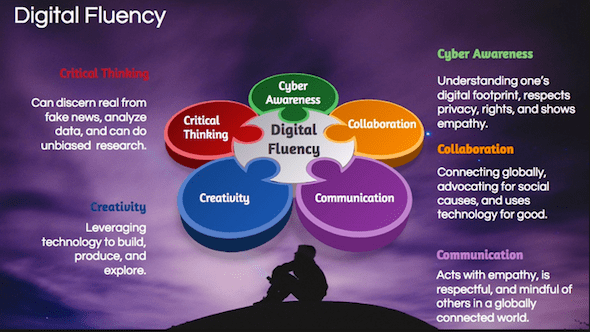
Digital Fluency is the ability to effectively use technology, devises, their tools, systems, apps and understand how they work. (Core Education, 2016)
Many students enter school with a basic knowledge of digital technology and it is the role of educators to help progress them from Digital Neophytes or beginners to Digitally fluent by the end of primary and beginning of secondary education.
Prensky (2012) referred to young people as being “digital natives” – the first generation to grow up embedded in new technology. Spending their entire lives surrounded by and using computers and other digital devices. (Mac Manus, 2013) It has become an expectation that the learning aspect of their lives will also be enriched with digital technology.
Education for individuals has become lifelong learning. Therefore teachers must continue to educate themselves on the different forms of technology tools available. (Howell, 2012) Refining digital skills in students can be achieved by purposeful activities, which build upon and expand their current skill base. Teachers can start to incorporate these types of technologies through creative activities in the classroom and help move students towards becoming digitally fluent.
Jennifer Howell provides a checklist including such things as proficiency in using Microsoft Word and Excel to more complex tools that aid in tasks such as creating websites, podcasts and Animation storyboards.
In 2002, Resnick predicted that ‘digital fluency will become a prerequisite for obtaining jobs, participating meaningfully in society, and learning throughout a lifetime. (Resnick, as cited by White, 2013). ‘He went on to say that students would need to be fluent online and fluent in critical thinking, collaboration and deciding relevancy.’
The Australian Curriculum (ACARA, 2015) highlights that students refine these technology-based skills through effective and appropriate guidance and support from educators.
“In simple terms, a digital pedagogy is the study of how to teach using digital technologies”. (Howell, 2012)
It is apparent that teachers must become fluent in a variety of technology tools to help their students learn and discover new ways of thinking, creating and behaving with digital technology, enabling them to participate appropriately now and into the future.
(Good, 2016)
Creative video to inspire people to become digitally fluent in our ever increasing digital society
Reference
Australian Curriculum, Assessment & Reporting Authority (ACARA). 2015. Information & Communication Technology (ICT) Capability. Retrieved from https://www.australiancurriculum.edu.au/f-10-curriculum/general-capabilities/information-and-communication-technology-ict-capability/?searchTerm=Technology+#dimension-content
Core Education. (2016). 10 Trends, Digital Fluency. Retrieved from http://www.core-ed.org/research-and-innovation/ten-trends/2016/digital-fluency/#resources-explain
Ed Tech Team. (2018). Digital Fluency. [Digital Image]. Retrieved from
https://www.edtechteam.com/blog/2018/09/fostering-digital-fluency/
Good, J. (Producer). (2016, January 23). Digital Fluency. [Video file]. Retrieved from
https://www.youtube.com/watch?v=lglIKLPkMqk
Howell, J. (2012). Teaching with ICT: Digital Pedagogies for Collaboration and Creativity. University of Oxford. South Melbourne, VIC
Lovejoy, B. (2016). iPads as effective on kids as sedatives at calming them before surgery – medical study. [Digital Image]. Retrieved from https://9to5mac.com/2016/08/30/ipads-as-effective-as-sedatives/
Mac Manus, S. (2013). Getting Young People Fluent in Digital. The Guardian. Retrieved From https://www.theguardian.com/social-enterprise-network/2013/aug/02/young-people-fluent-digital
Prensky, M. (2001). Digital Natives, Digital Immigrants. On the horizon, MCB University Press. Vol 9, No 5. Retrieved from http://www.marcprensky.com/writing/Prensky%20-%20Digital%20Natives,%20Digital%20Immigrants%20-%20Part1.pdf
Ryan, T. (N.D.). Digital Fluency. [Digital Image]. Retrieved from https://www.pinterest.com.au/TeachJay/digital-fluency/?lp=true
The Age. (2011). Kids iPad Screenshot. [Digital Image] Retrieved from https://www.theage.com.au/national/victoria/schools-ponder-if-an-apple-a-day-keeps-ignorance-at-bay-20110730-1i5kr.html
Voki. (2018). [Digital Image]. Retrieved from https://www.voki.com/
White, G. (2013). Digital Fluency: Skills necessary for learning in the digital Age. Retrieved from https://research.acer.edu.au/digital_learning/6/
 Teaching and Learning in a Digital World