Written Summation
Lifelong learning refers to ongoing, independent and self-motivated learning. It can be in pursuit of knowledge for either personal or professional reasons and happens throughout our life. It not only enhances social inclusion and personal development, but also self-sustainability, as well as competitiveness and employability. (Tumson, 2012)
Rapid and continuing advances in Information and Communication Technologies (ICT) are changing the ways people share, use, develop and process information and technology. (Howell, 2012) With the internet providing an abundance of information effortlessly, and academic institutes embracing this change by providing more online courses, learning has never been easier to achieve.
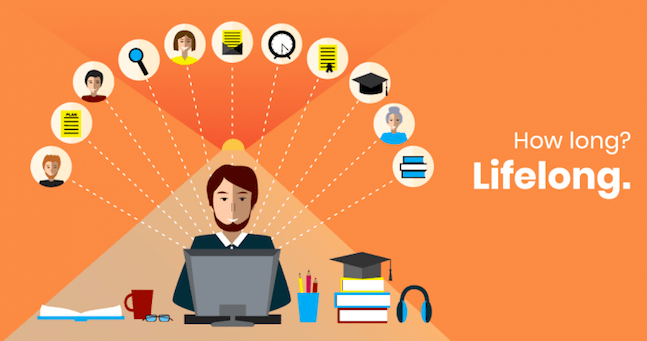
In preparing students for lifelong learning, the Australian government has two main policies helping shape the way schools are preparing them for the digital world. The Digital Education Revolution (DER) along with the Melbourne Declaration on Educational Goals for Young Australians (established 2008) is promoting a world-class curriculum and assessment program. Creating a foundation for students to develop ICT competence with the opportunity to harness and develop these digital skills throughout their education. (Howell, 2012)
As Howell (2012) stated, “it is an exciting time in Australia with the new Curriculum and its clear prioritising of technology as a key competency.” Lifelong learning is a growing demand to keep up with our knowledge-based digital society and is essential for teachers to model lifelong learning to their students. Using technology, teachers can create Personal Learning Environments (PLE) and Professional Learning Networks (PLN). PLE means to collect from many different sources, appropriate information pertaining to your interests. Students can create their own PLE on specific topics/subjects. Symbaloo & Wakelet are some examples of PLE programs. PLN refers to personal connections you network with in your field of work/interest (such as LinkedIn) and share ideas with. By creating PLE & PLN tools in class, models to students the importance of lifelong learning. (Bringham, 2016) In this digital age, young people need to be highly skilled in the use of ICT and Lifelong learning.
“The capacity to learn is a gift; the ability to learn is a skill; the willingness to learn is a choice.” (Herbert, 2014)
This video, created by Bringham University (2016) acknowledges the importance of lifelong learning and the impact educators have on students by modelling these practices.
References
Andriotis, N. (2018). 7 Ways to Encourage Lifelong Learning in Your Business. [Digital Image]. Retrieved from https://www.efrontlearning.com/blog/2018/07/ways-encourage-lifelong-learning-for-employees.html
Brigham University. (Producer). (2016, May 11). Lifelong Learning for teachers. [Video File]. Retrieved from https://youtu.be/NSU2hdlY3BY
Cochran, A. (2018). Technology resources for lifelong learners. [Digital Image]. Retrieved from https://beaconseniornews.com/talking-digital/technology-resources-lifelong-learners/
Herbert, B. (2014, August 25). You can change who you are by changing what goes in your mind. Monday Morning Motivation. [Blog Post]. Retrieved from http://harleyinspiration.blogspot.com/2014/08/brian-herbert.html
Howell, J. (2012). Teaching with ICT: Digital Pedagogies for Collaboration and Creativity. University of Oxford. South Melbourne, VIC
Tumson, A. (2012) The meaning of lifelong learning in a digital age. Retrieved from https://www.howtolearn.com/2012/10/the-meaning-of-lifelong-learning-in-a-digital-age/
 Teaching and Learning in a Digital World